Ohio Workers’ Compensation: Group Rating vs Retro
Ohio workers' compensation is different than most states. In most places, businesses can shop...
March 9, 2026Here's What Most Ohio Businesses Do When it comes to Workers’ Compensation
Most Ohio businesses handle workers' compensation the same way because it feels like something that's already taken care of.
All businesses register with the Ohio Bureau of Workers' Compensation, which is the state system every employer has to use here. They get their rate, start paying premiums, and at some point a broker may move the business into something like Group Rating or another program.
Renewal comes around every year, paperwork gets signed, and unless something goes seriously wrong, it rarely gets a second look. Not because anyone's careless, but workers' compensation just feels technical, regulated, and handled. So it stays on autopilot.
The problem is, Ohio isn't just about what program a business is in, it's about who actually owns the outcome after an injury.
Where money starts drifting is what happens after claims occur. Someone gets injured, the claim gets filed, and the business moves on to the next issue. But what happens after the injury is what really affects cost: how long someone stays off work, whether a claim stays open longer than it needs to, and whether anyone is watching how those claims develop.
Most companies don't actively manage that part because nobody ever told them they could.
And here's what most Ohio business owners never hear: they're not stuck with whatever they're paying. Ohio doesn't let employers shop carriers, but there are a few common paths businesses end up in, which commonly includes Group Rating, Retro, Self-Insurance, or a PEO/ASO/AEO model. Most businesses are in one of these, and a lot of them haven't revisited whether it still fits.
Your Workers' Compensation Options in Ohio
In Ohio, employers can't shop workers' compensation carriers. The Ohio Bureau of Workers' Compensation (BWC) is the system. What employers can choose is the path they take inside it. Most end up in one of four setups: Group Rating, Retro, Self-Insurance, or a PEO/ASO/AEO model. Each one changes cost, risk, and how hands-on the company has to be after injuries happen. For a broader look at how these options compare to what employers in other states can do, see our breakdown of the different ways businesses can obtain workers' compensation coverage.
Ohio BWC Group Rating (steady discount, lower risk)
Group Rating is the most common option because it's simple and predictable. An employer joins a BWC-approved group through a sponsor, which is often an industry association or a TPA (third-party administrator), a company that helps manage workers' compensation programs, paperwork, and often claims coordination. The premium gets a discount based on how the group performs overall. If the group runs clean, the discount holds. If the group has a bad year, the discount shrinks.
This tends to fit small and mid-size employers that want savings but don't have someone treating workers' compensation like a weekly job. In a lot of companies, the owner is still running operations and the "HR person" is also doing payroll and onboarding. Group Rating works well in that reality because it usually lowers the bill without introducing surprise assessments later.
The main reason Group Rating is popular is timing. Savings show up directly in the premium during the policy year. There's no waiting for refunds and no surprise assessment. For most small and mid-size employers, it's the smart default.
Ohio BWC Retro (bigger savings, performance-based)
Retro (short for retrospective rating) has more upside, but it's not passive. Instead of a clean discount up front, Retro adjusts costs later based on how claims actually develop. If claims stay low and close cleanly, results can beat Group Rating. If claims drag, costs go up.
Retro usually fits employers that already run a tight process after an injury. Injuries get reported the same day. Restrictions get tracked. Modified duty is normal. Someone checks open claims regularly so nothing drifts for months. It doesn't require a massive safety department, but it does require consistency. If workers' compensation is on autopilot today, Retro tends to create headaches. If claims are actively managed, Retro can pay off.
If the difference between Group Rating and Retro still feels fuzzy, we break it down in more detail here: Group Rating vs. Retro.
Ohio Workers' Compensation Self-Insurance (big companies only)
Self-insurance is when an employer meets BWC requirements and takes on the financial responsibility for claims directly. This is usually a large-employer move. It can make sense when there's enough scale, cash flow, and internal infrastructure to handle claims without disruption.
Most small businesses aren't a fit for self-insurance for one simple reason: a serious claim can create a cash-flow emergency. Self-insurance is typically for companies that can absorb that risk and have people in-house who live in claims and risk management.
PEO/ASO/AEO model (outsource HR administration, or shift how workers' compensation is structured entirely)
These three models often get lumped together, but they work differently and serve different goals.
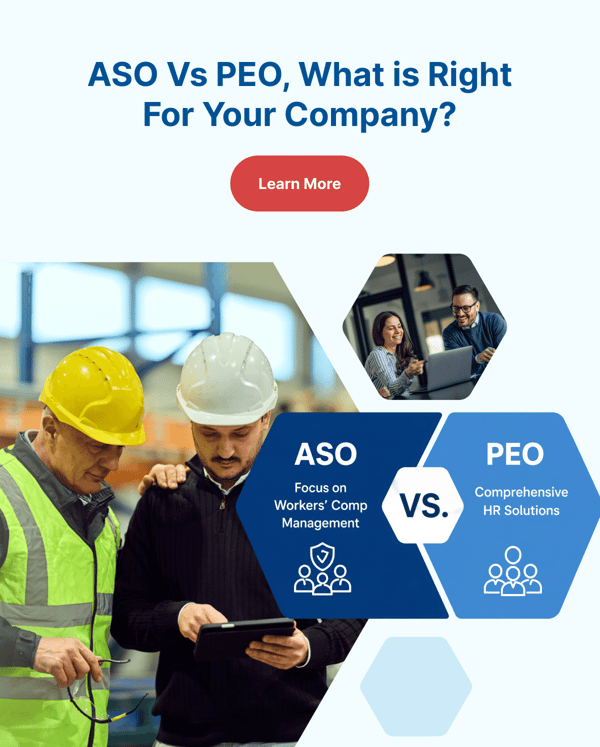
A PEO (professional employer organization) enters a co-employment arrangement with the business. The PEO becomes a joint employer of record, taking on certain HR and employment liabilities alongside the company. Payroll, benefits, compliance, and workers' compensation are all handled through the PEO's infrastructure. This is usually chosen by owners who don't want to run HR internally and want a single partner handling the administrative side of employment.
An ASO (administrative services organization) provides the same administrative services as a PEO but without co-employment. The client company stays the employer of record and retains full employer liability. The ASO handles the paperwork and administration. For businesses that want HR support without giving up control of their employment relationships, an ASO is often the cleaner fit.
An AEO (alternate employer organization) is an Ohio-specific model. The AEO becomes the employer of record specifically for workers' compensation purposes, allowing the business to operate under the AEO's BWC policy and claims infrastructure rather than its own. This is a meaningful distinction: the business isn't outsourcing HR broadly, it's restructuring how workers' compensation risk and claims are handled at the source. Alloy operates as an AEO, which is what allows it to directly own claims outcomes rather than managing them from the sidelines. You can read more about how Ohio employers can structure their workers' compensation coverage and where each of these models fits.
For businesses mainly trying to lower workers' compensation costs without overhauling how HR is run, a PEO or ASO is usually not the most direct path. An AEO model is worth understanding separately because the goal is different.
How to Choose the Right Ohio Workers' Compensation Option
Most Ohio businesses can rule out one or two options immediately. Self-insurance is usually a clear "no" unless the company is large, has serious cash flow, and has people in-house who live in risk and claims. The PEO/ASO/AEO question is also usually a clear yes or no depending on what problem the business is actually trying to solve. If the goal is to outsource HR administration broadly, payroll, benefits, and compliance, a PEO or ASO can make sense. A PEO brings co-employment and shared liability; an ASO provides the same administrative support while the business stays the employer of record. If the goal is specifically to restructure how workers' compensation risk and claims are managed, an AEO is the more direct path. For businesses mainly trying to lower workers' compensation costs without changing how HR is run, a PEO or ASO usually isn't the most efficient route.
For most small and mid-size employers, the real decision comes down to Group Rating versus Retro. Those are the two lanes where the savings are meaningful and the trade-offs actually matter. Here's how to think about it without overcomplicating it.
The first question is simple: what does the claims history actually look like? If a business has low claim frequency and claims tend to close cleanly without turning into long-duration situations, Retro starts to make sense. Retro rewards clean performance. On the other hand, if claims are inconsistent, repeat injuries keep popping up, or claims tend to stay open longer than they should, Group Rating is usually the safer play because it's less sensitive to the way individual claims develop over time. And if nobody in the company can answer basic questions about claims history without calling someone, that's usually a sign the business isn't ready for Retro yet. Understanding what drives workers' compensation costs is a useful starting point for evaluating where a business actually stands.
The second question is: who is managing claims after they happen? This is where most businesses get tripped up. Retro can work well when someone is actively tracking open claims, coordinating medical direction, keeping restrictions clear, and pushing return-to-work so claims don't drift. That doesn't require a huge safety department, but it does require ownership. If claims get filed and then nobody looks at them again until a broker or adjuster sends an update, Retro usually creates problems. In that situation, Group Rating fits better, and the real priority should be building the basic habits that keep claims from dragging in the first place. For a practical look at what proactive claims management actually involves, see our top 7 ways to control workers' comp costs.
One of the biggest controllable factors in keeping claims from becoming expensive is reducing lag time, which is the gap between when an injury happens and when it gets reported, treated, and managed. The longer a claim sits untouched, the more it costs.
The third question is: how much year-end variability can the business tolerate? Retro has more upside, but it comes with variability. Refunds can happen when performance is strong, and assessments can happen when it isn't. Group Rating's savings show up directly in the premium during the policy year, no waiting, no surprises. If cash flow stability matters, Group Rating is usually the better fit.
The bigger point is this: this isn't a "set it once and forget it" decision. Businesses change. Payroll changes. Turnover changes. Claims history changes. Management capacity changes. A lot of companies were placed into a program years ago and never revisited whether it still fits. The right answer can shift as the business grows, claims improve, or the company gets more disciplined about what happens after an injury.
Once the option that fits is clear, the next step is understanding how Ohio actually calculates workers' compensation costs and why these programs create savings. That's what makes the decision feel concrete instead of confusing.
How the BWC System Works - And What Sets Alloy's AEO Model Apart
Understanding how Ohio's BWC system sets costs makes program choice a lot easier.
Ohio uses a manual rate system. Each job classification has a baseline rate tied to payroll, and those rates are set by the state. A warehouse role gets one rate, roofing gets another, and higher-risk work costs more before claims even enter the picture. For a closer look at how premiums are calculated and what factors move costs up or down, see our guide on how much workers' compensation insurance should cost.
The place a business's performance shows up is the experience modification factor, or "mod." A lower mod means fewer or less expensive claims compared to similar employers, which lowers the premium. A higher mod means more claims or higher-cost claims, which raises it. And because the mod is calculated using multiple years of claims history, a claim that drags out doesn't just hurt once, it can weigh on costs for years. The Ohio BWC's rating detail system allows employers to review the claims and payroll data used to calculate their mod, which is a useful starting point for understanding where costs are coming from.
That's the backdrop for the four standard paths most Ohio employers land in: Group Rating, Retro, Self-Insurance, or a PEO/ASO/AEO model. They're different ways to reduce the baseline cost, change how pricing is calculated, or shift how claims are administered. But most of them share a common weakness: they're built around a passive claims experience. Someone gets hurt, the claim gets handed off, and the business waits for updates while costs develop in the background.
Alloy operates as an AEO, but the model goes further than most. As the employer of record for workers' compensation purposes, Alloy assumes the financial risk for claims directly and creates a dedicated claims fund for each client. That's different from an AEO that simply provides access to a shared BWC policy. When Alloy owns the financial exposure, it has every reason to manage claims like they're its own, because they are. You can learn more about how that model works on the Alloy workers' compensation page.
That means proactive claims management focused on speed and control: fast reporting, clean documentation, coordinated medical direction, and return-to-work that's planned instead of improvised. The goal is simple, fewer long-duration claims, because long-duration claims are what blow up total cost and drag the mod in the wrong direction. Focusing on injury prevention and worksite safety is the single most effective lever for keeping those costs from compounding over time.
Alloy also integrates wellness in a practical way. Not gym perks. Not "free fruit." The point is preventing the predictable drivers of expensive claims before they happen. Preventative health programs help employers address root causes before they turn into costly claims. We work with our clients to eliminate repeat strain patterns, delayed care, chronic issues that slow healing, and stress that increases risk and extends recovery time. This approach is part of Alloy's broader Total Risk Shield model, which integrates workers' compensation, wellness, and compliance into one unified strategy.
This is why Alloy clients often see results standard programs don't deliver: fewer claims that drift, faster claim resolution, and better mod performance over time. Results depend on industry and claim history, but when claims stop dragging, costs stop rising by default. For businesses in high-risk industries like manufacturing, proactive claims management can make an even bigger difference.
Mental health claims are also becoming a larger factor in workers' compensation costs. Employers that integrate wellness programs addressing both physical and mental health tend to see better overall outcomes and lower claim frequency. For a deeper look at how mental health intersects with workers' compensation, see our guide on 10 things employers need to know about mental health claims. Alloy's wellness initiative is built around exactly that, connecting mental health support, lifestyle management, and injury prevention into one practical program.
Want to see how Alloy's model compares to what your business is paying now? Get started with a free analysis.



Let’s see if we can lower your workers’ comp expenses.

Do you need help with Workers' Comp, Payroll, or Employee Benefits? Let's quote your solution.